Table of Contents
A. Project Overview
B. Preamble
C. Geometrical Representation
D. Concept Art Aesthetics
E. War Machines
A. Project Overview
"Metal Fear" is one of my favorite projects. It draws inspiration from industrial design and concept art aesthetics found in the Metal Gear IP. This project focuses on modeling hard surface models with distinct shapes and imbuing these models with a fearsome appearance through specific design elements. Technically, this project is a successor to the "Mech Warrior" project. All models and renders featured in this project were created using the free 3D voxel graphics software MagicaVoxel by Ephtracy. Post-processing was done with Photoshop.
How to read this page?
- Start with the design rationale before looking at the vehicle gallery.
- Read the geometrical logic and post-processing notes as part of the concept workflow.
- Treat each vehicle as a variation of recurring system clusters, not as an isolated design.
B. Preamble
The machines in Metal Fear are characterized by defined geometrical shapes, resembling the technical structures of heavyweight vehicles such as cranes, bulldozers, tanks, and other armored machines. These structures are designed according to the principle of "form follows function." The primary purpose of these machines is to be physically robust, easy to manufacture, and easy to maintain. Consequently, their geometrical shapes are technically crude and robust, rather than organic. Another limiting factor in their design is the production scale. Unlike consumer electronics or cars, these heavyweight machines are manufactured in smaller lots, necessitating standardized geometrical clusters and features in their structural design. A distinctive design aspect of Metal Fear vehicles is their incorporation of anatomical features found in life forms like spiders, crabs, snakes, etc. For example, adopting extremities from spiders makes the concept design more intimidating.
The core idea is not biomechanical realism, but the selective borrowing of threatening anatomical cues and translating them into manufacturable industrial forms.
C. Geometrical Representation
MagicaVoxel offers an efficient method for creating "hard surfaces" using voxels, as opposed to the more expensive 3D CAD or less precise 3D polygon modeling software. Hard surfaces with defined bevels, transitions, and undercuts can be modeled with voxels, utilizing "marching cubes" shapes during rendering. Another advantage of using the "marching cubes" representation is that these concepts appear super sharp and credible. Generating complex models with cool designs is time-consuming. To manage this complexity, I decompose the overall architecture of the model into logical elements, like found in systems engineering methodologies. From a professional perspective, we refer to this as "Modularity". In the 3D modeling community a familiar approach exists which is also known as "kitbashing".
Modularity
In industrial design, modularity is a key engineering technique that enables the creation of complex systems from smaller, independent subsystems, demonstrating versatility across various fields. In graphic design, particularly in the 8-bit and 16-bit video game era, modularity was exemplified through pixel graphic tiles, which were used as fundamental elements to construct intricate visual landscapes. This approach not only addressed technical limitations of the time but also fostered innovation and creativity, significantly impacting the gaming industry and beyond.
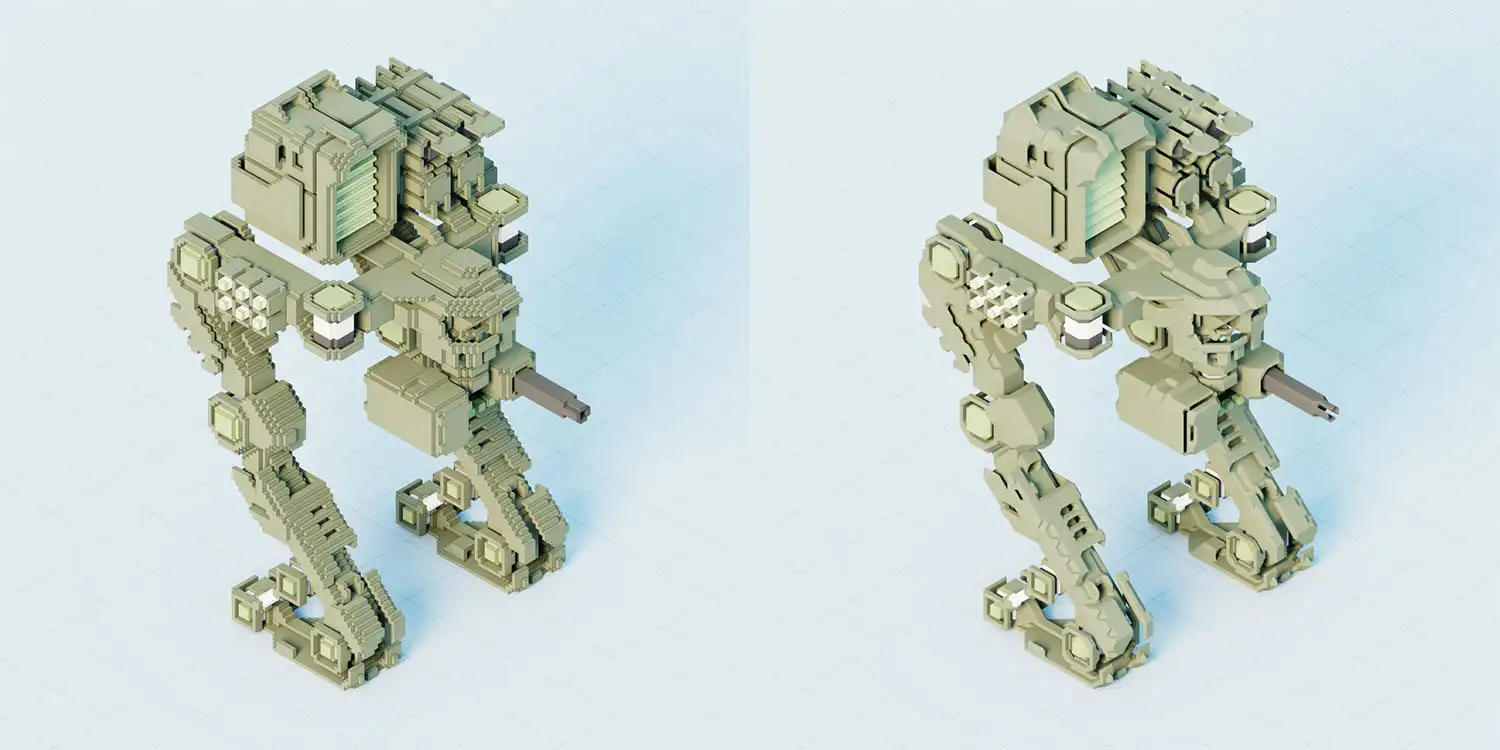
Voxel vs. Marching Cubes render mode - ボクセル対マーチングキューブレンダーモード
In a figurative sense, this means I divide the geometrical body of a Metal Fear vehicle into the following logical subsystems:
System Breakdown
- drive & joints,
- cockpit & control,
- armament,
- cooling & ventilation etc.
If I do that, I end up with a nice collection of logical elements that can serve as a basis for different vehicle platforms.
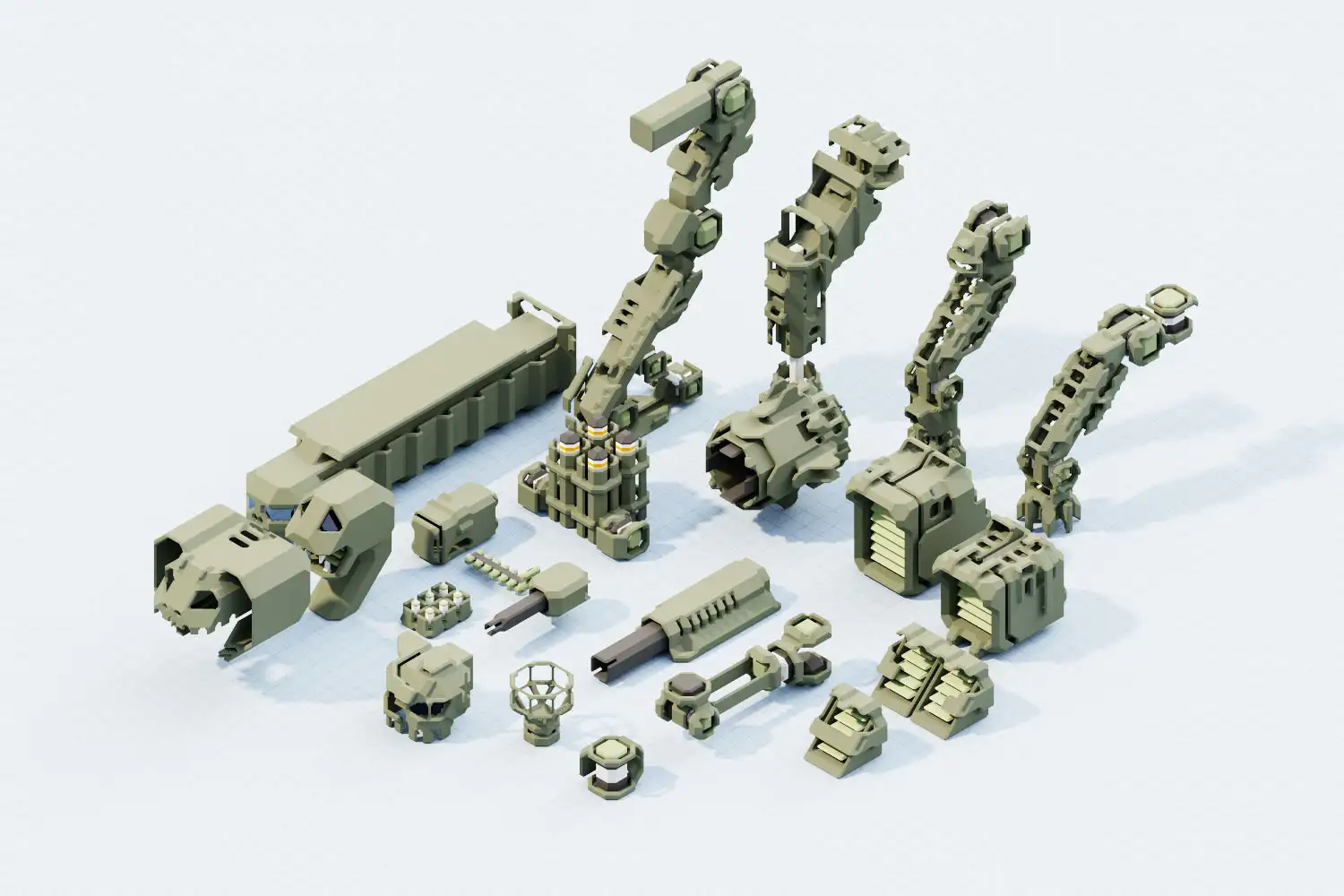
Decomposition of system architecture (kitbashing) - システムアーキテクチャの分解(キットバッシング)
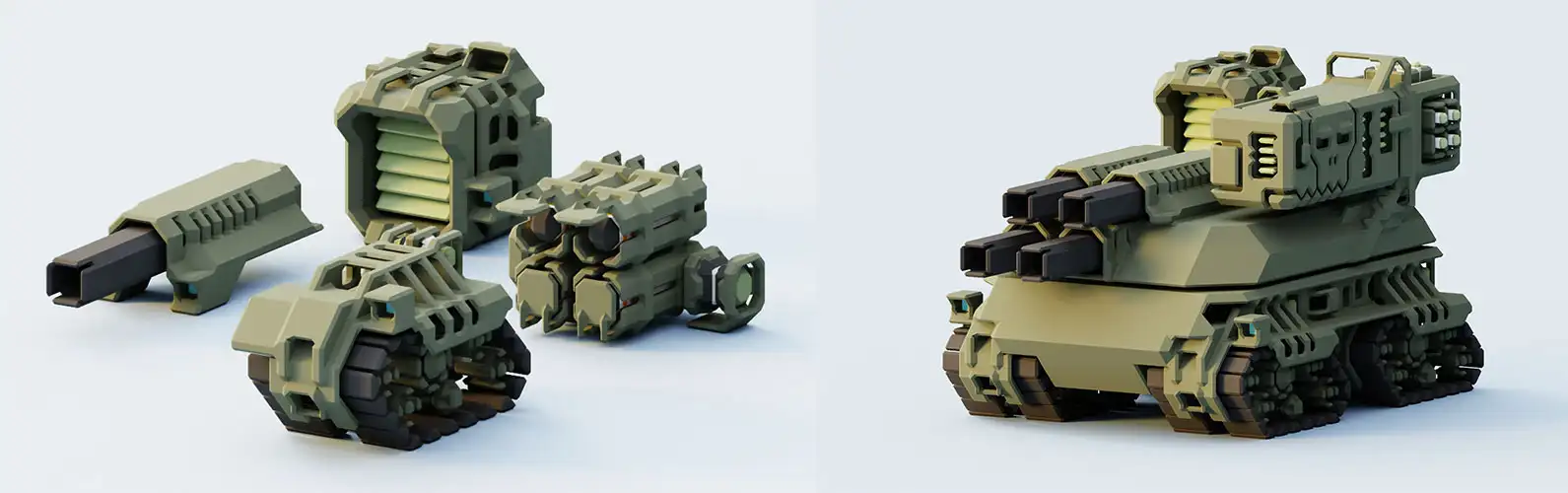
Vehicle concept design by assembling systems - システムの組み立てによる車両のコンセプトデザイン
During my 1st modelling approaches in MagicaVoxel - which began in mid 2019 - my mechanical models models become more styled. Between the evolution steps I added details and made the concept designs more asymmetric. In my opinion "Asymmetry" is a very important factor in industrial design and beyond.
Asymmetry
Asymmetry is the violation of symmetry. Asymmetry is an important characteristic in biological organisms. Benefits of asymmetry sometimes have to do with improved spatial arrangements. From industrial design perspective the division of functionality between right and left may be beneficial too. In terms of efficiency and costs redundant components can be substituted and may lead to asymmetreical design. Deliberate usage of asymmetry can make a product design more interesting, less monotonous and more useful especially in terms of enhancing the user experience.
Design Rules
1 Break large vehicles into reusable structural clusters.
2 Favor legible silhouettes over ornamental detail.
3 Let subsystem placement communicate function.
4 Standardization creates credibility in small-batch military hardware.
5 Kitbashing is most effective when the design language remains consistent.
6 Use assymetry to make the design more interesting and unique.
D. Concept Art Aesthetics
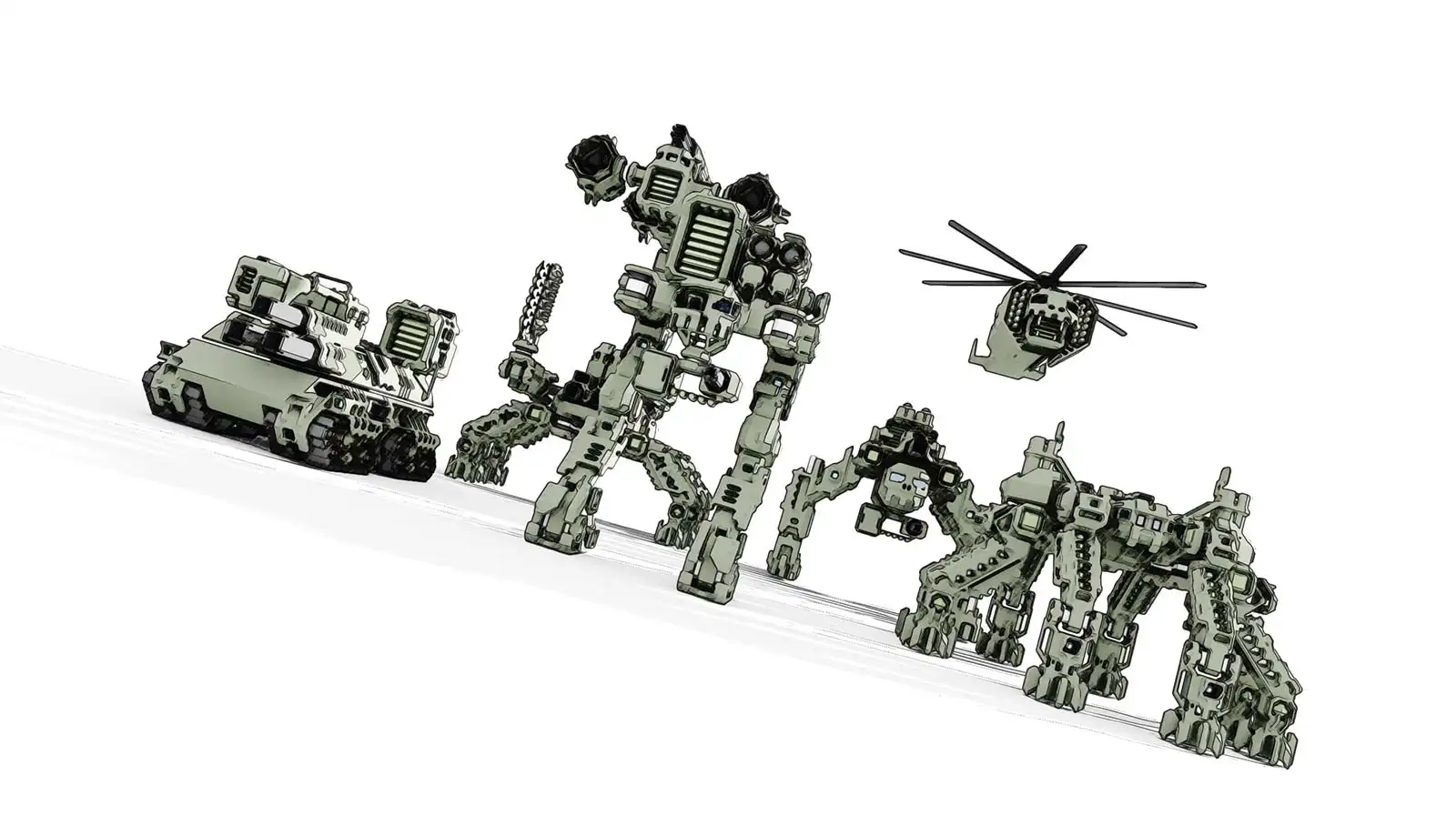
Yoji Shinkawa, the lead character and mech designer for the Metal Gear series, introduced a striking art style technique. His art is renowned for its rough sketches, crisp outlines, and the use of watercolor effects. Additionally, he employs cinematic poses and perspectives to effectively stage his characters and objects. Applying perspective views is straightforward in 3D rendering. However, the final 3D render outcomes can sometimes appear too sterile or even unspectacular. Therefore, some post-processing in conventional 2D software is necessary to make the concept design stand out.
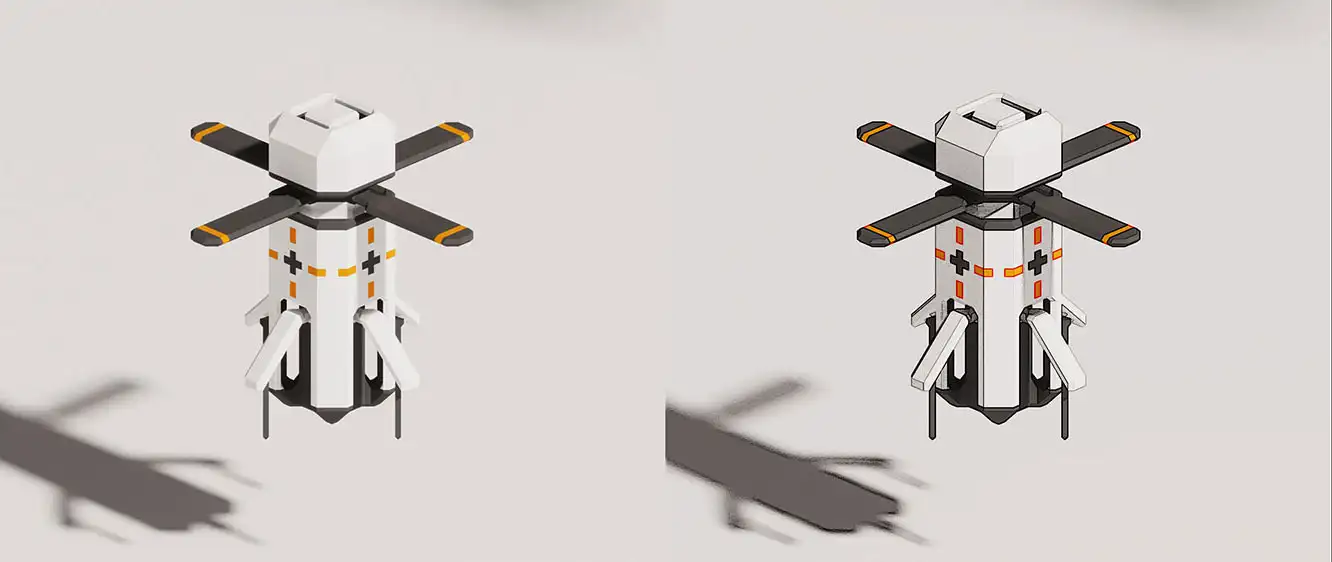
Filter-generated outline drawing effect - フィルター生成のアウトライン描画効果
You have two options here. If you have the skills, you can do the job manually, which results in a more natural look but takes considerably more time. Alternatively, if your skills are lacking, you're short on time, or you simply prefer an easier route, you can opt to use filters. Modern 2D bitmap software comes equipped with the right tools to assist you in this process. For instance, in Adobe Photoshop, ...
Workflow
- copy the layer with your rendered image,
- apply "find edges" filter on the copy,
- reduce saturation of that layer and,
- blend this layer via "multiplication".
Besides generating outlines, you can also create some dirty shading with grain. Add a camouflage texture while blending it with a "cloud" filter. Give the image more final touches using "charcoal," "tone separation," and "tone threshold" filters. This approach will give your render a dirtier, grunge look and make it appear less sterile. However, to achieve an outcome comparable to Yoji Shinkawa's work, you need to possess the skills and perform the entire post-processing manually by hand. Nonetheless, this effect seems promising and can serve as a good baseline for further experiments.
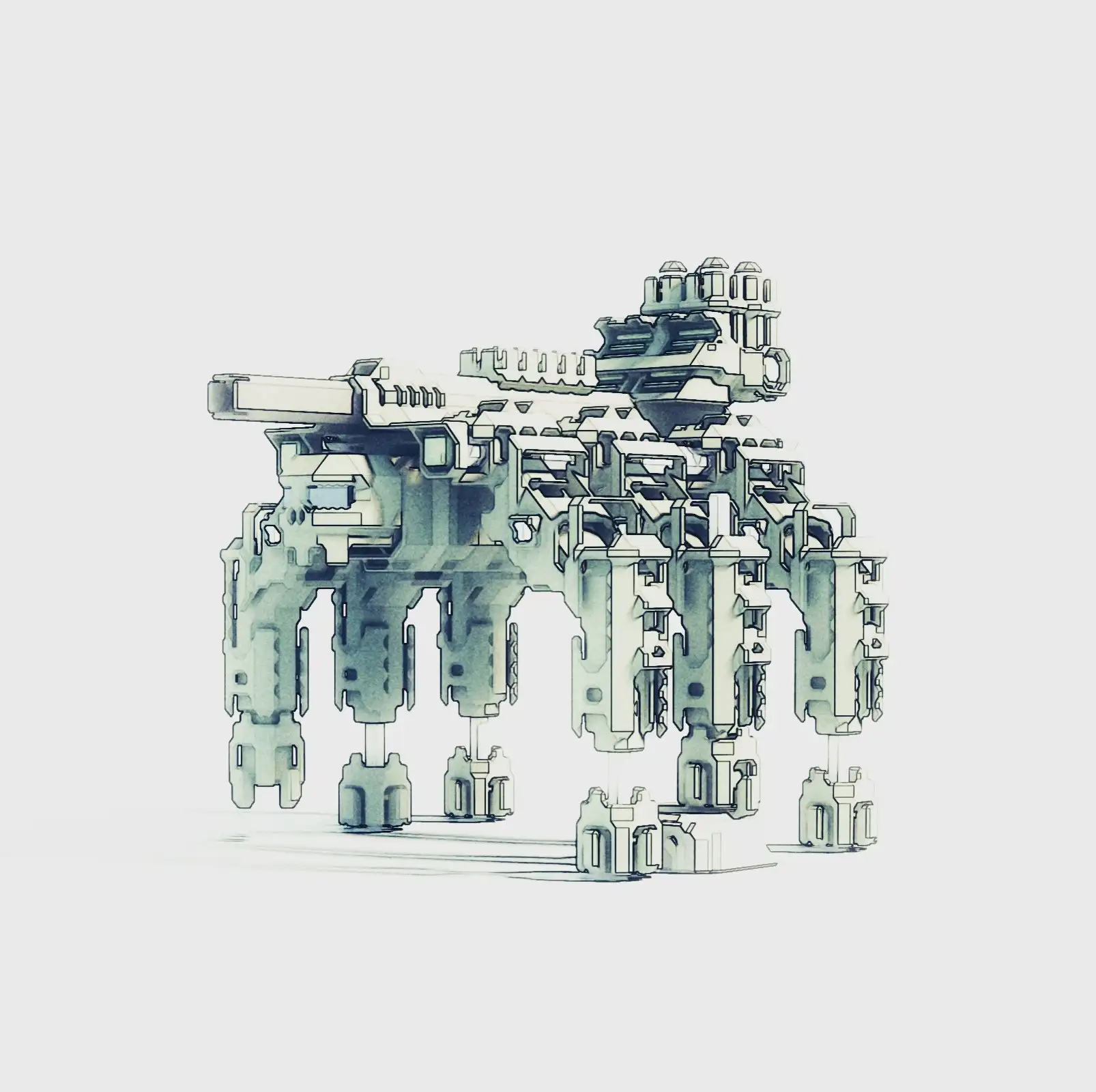
Filter-generated outline + some grunge textures - フィルター生成のアウトラインとグランジテクスチャ
E. War Machines
Codename: Stalker [コードネーム:ストーカー]
The Stalker is an All-Terrain Armed Scout (AT-AS), a lightweight, bipedal moving apparatus designed for reconnaissance ground operations in challenging terrain. It is equipped with a Gatling gun mounted on a rotating joint beneath the control cockpit. Additionally, it carries a cartridge containing four ballistic nuclear missiles and several air-to-air missile cartridges. Over time, I have refined the concept design, improving the center of gravity and making minor rearrangements of the missile cartridges and the position of the Gatling gun. Besides the "Asymmetry" of the mounted parts, another design characteristic of this vehicle is its distinctive ventilation devices attached to the main structure, which emphasize the general "industrial design" look of the vehicles in the Metal Fear project. This concept was the first in the Metal Fear project. The final mixed media artwork is a combination of a photograph and a 3D render. The base is a photograph taken with an iPhone SE (1st Gen) using the ProCamera app, combined with a MagicaVoxel marching cubes render. Retouching and post-processing were done in Photoshop, SnapSeed, and Procreate.
Stalker V1.0 - ストーカー V1.0
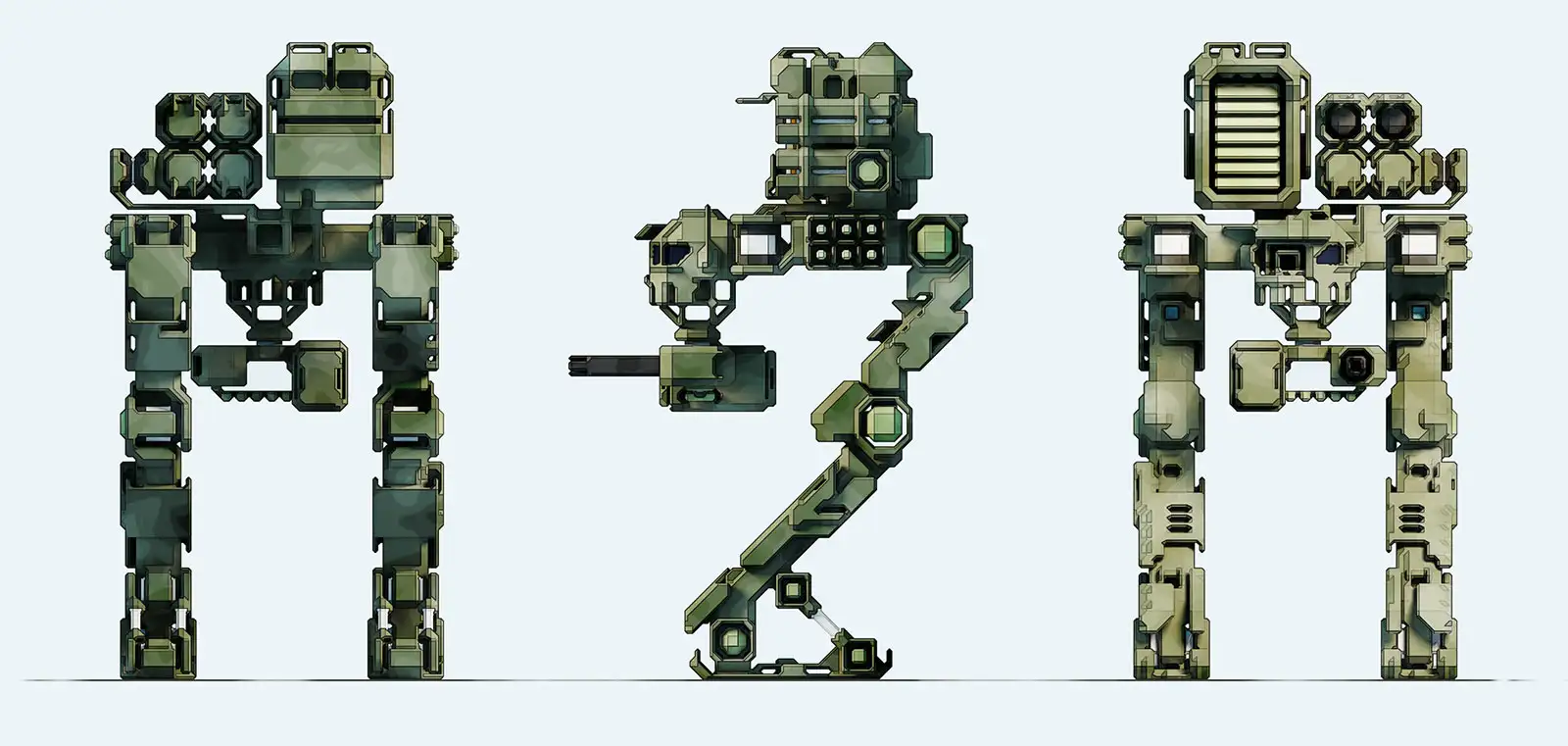
Stalker v2.0 with improved center of gravity and re-arrangement of air-to-air missile cartridges - ストーカー v2.0 重心改善と空対空ミサイルカートリッジの再配置付き
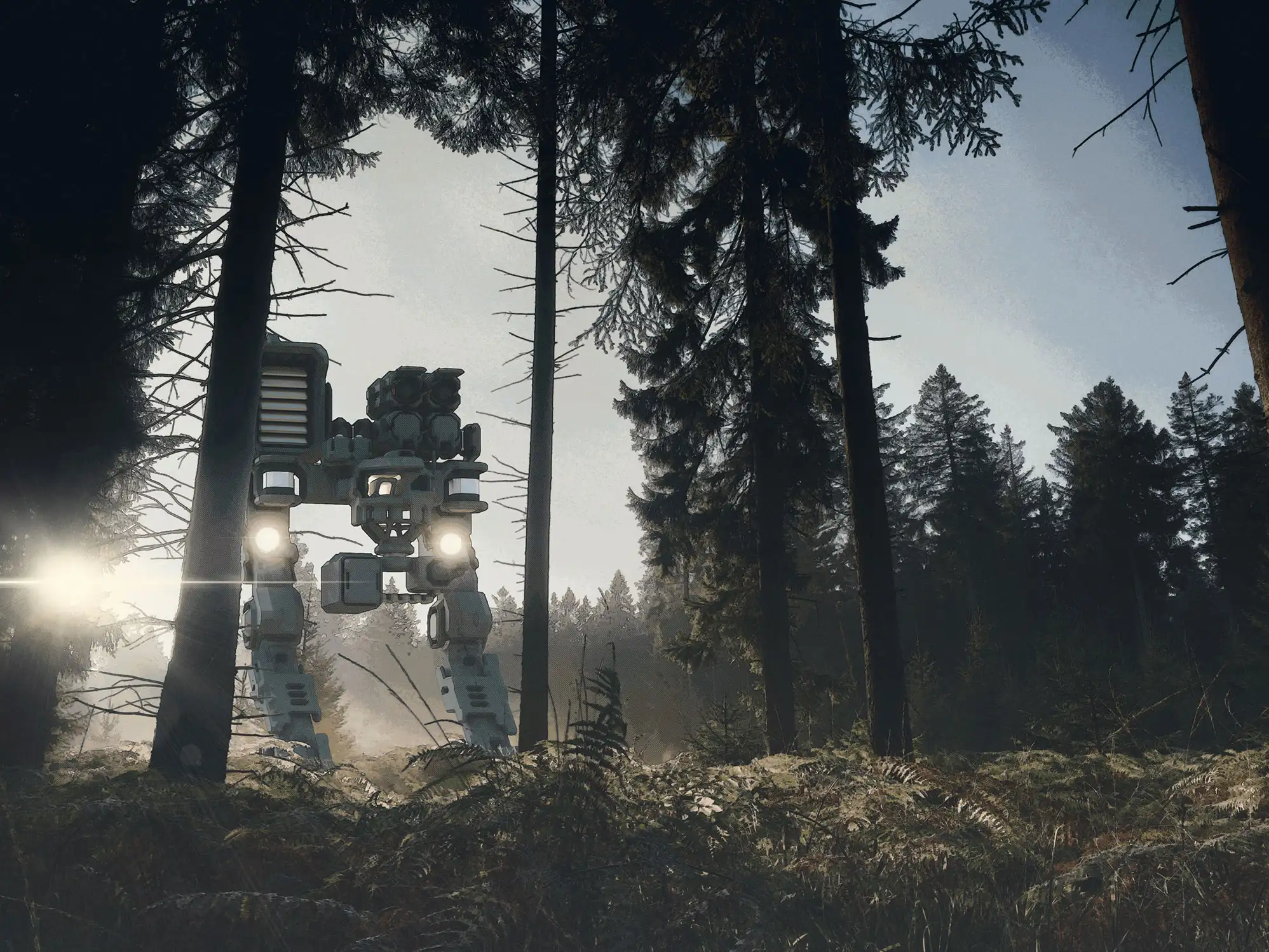
Stalker: All-Terrain Armed Scout (AT-AS) - ストーカー:全地形対応型武装偵察車(AT-AS)
Codename: Hexapod [コードネーム:ヘキサポッド]
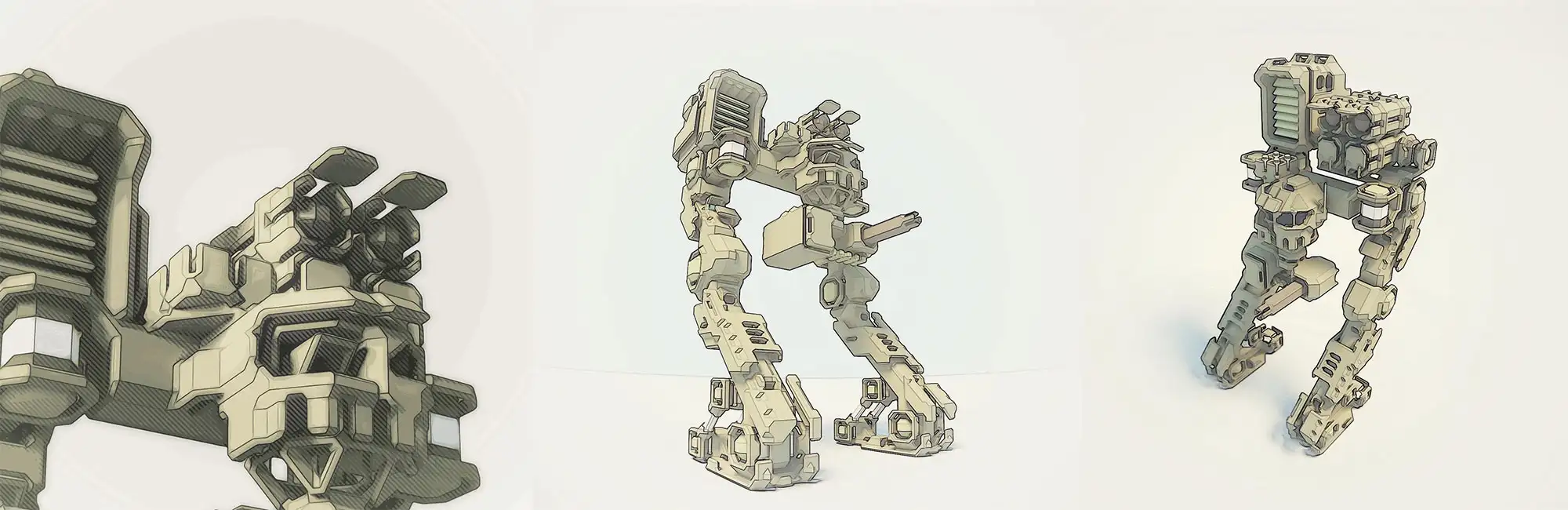
The Hexapod is a first-generation, multi-legged moving apparatus that serves as an All-Terrain Armed Troop Transporter (AT-ATT MK1). It is utilized for tactical defense operations on challenging terrain and is capable of crossing rivers and lakes. The vehicle's movement is achieved through a combination of linear movements of its six independent legs. Each leg contains a linear drive for vertical movements. Additionally, on each side of the vehicle, three legs are connected to a main longitudinal linear drive beam to enable independent longitudinal movements. The Hexapod's primary armament is a single cannon symmetrically placed atop the skull-shaped cockpit. The vehicle is equipped with a cartridge containing four ballistic nuclear missiles and several air-to-air missile cartridges. Prominent air outlets are also a feature in this design.
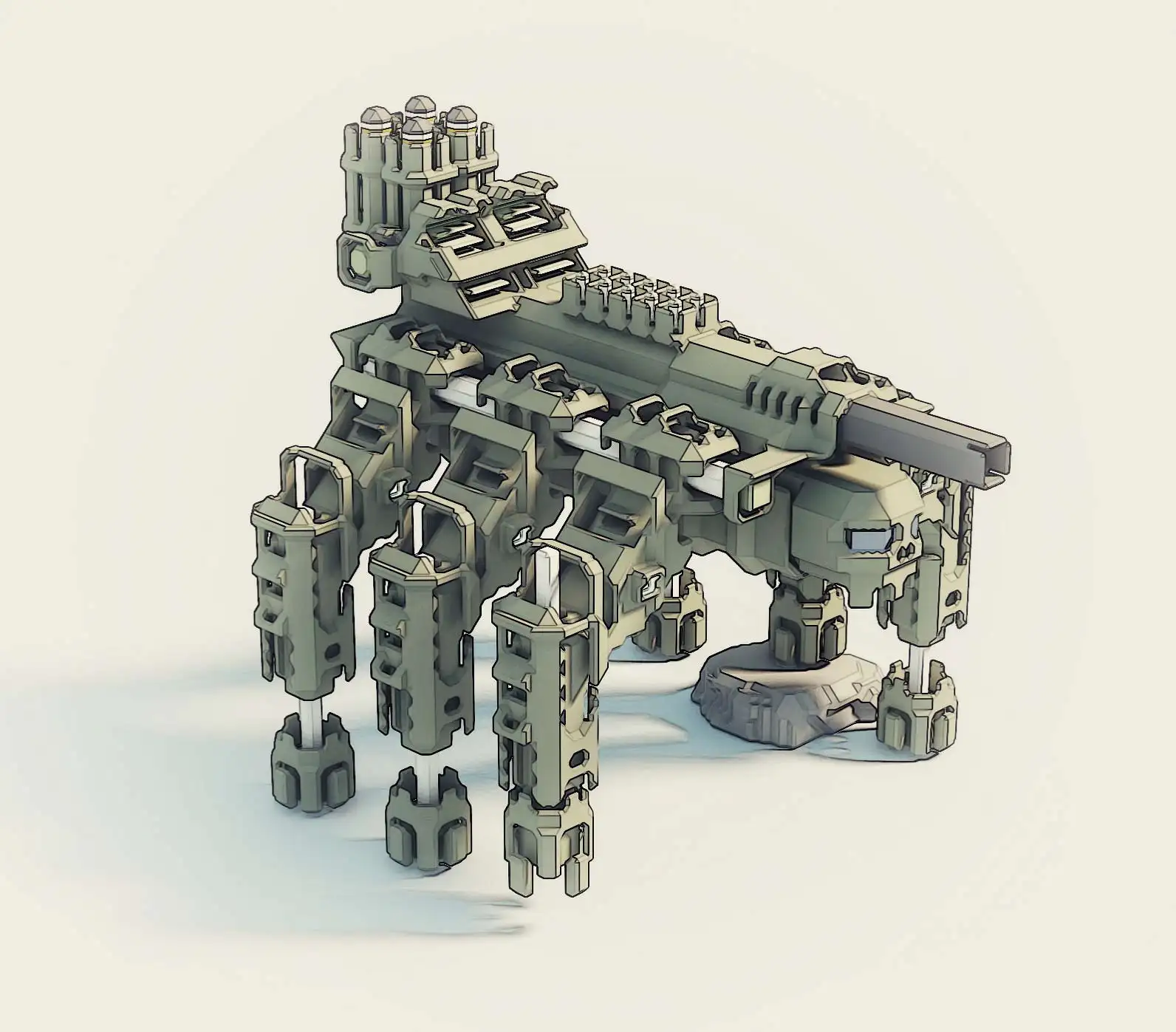
Hexapod: All-Terrain Armed Troop Transporter (AT-ATT) - ヘキサポッド:全地形対応型武装兵員輸送車(AT-ATT)
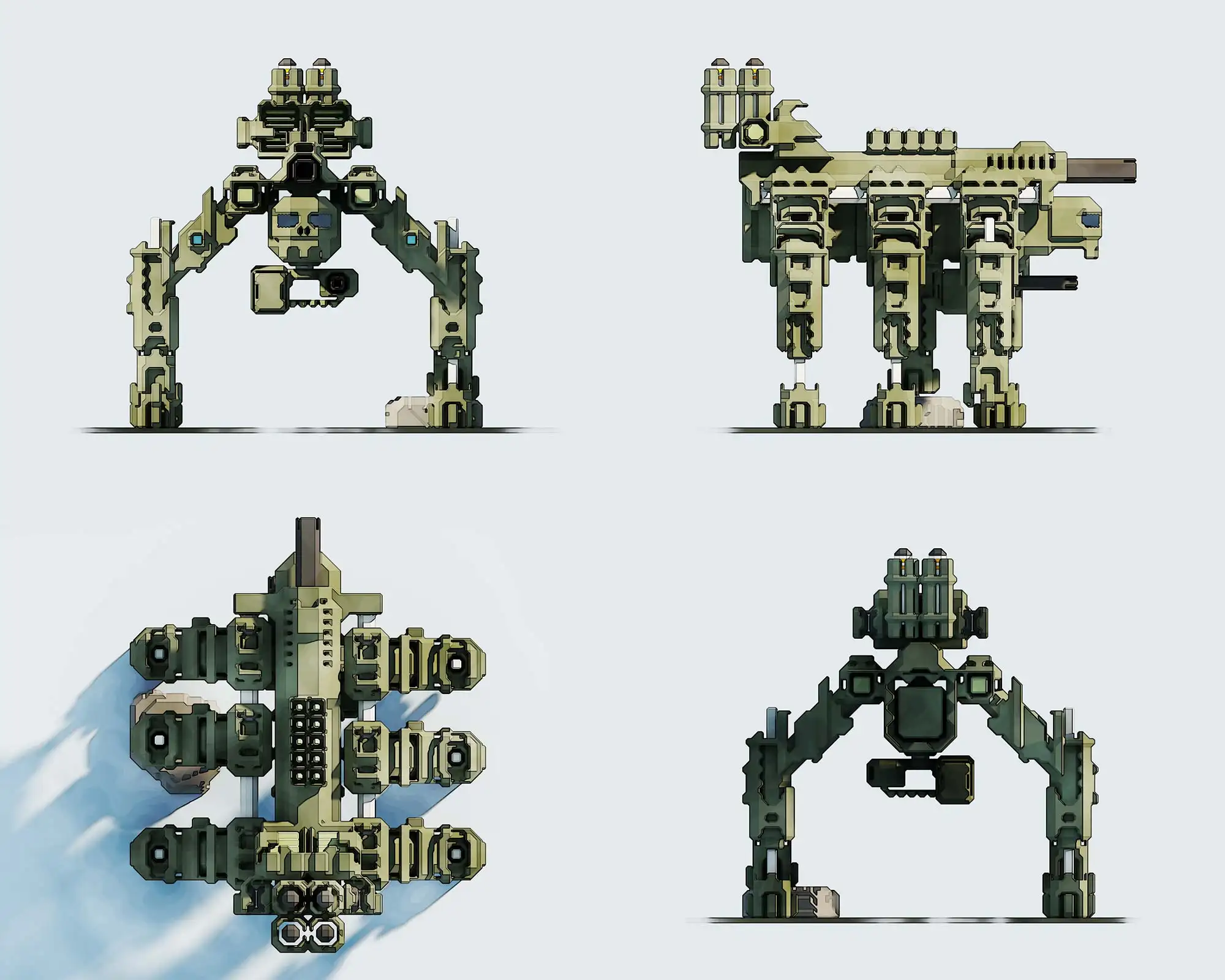
Hexapod: Silhouette Analysis - ヘキサポッド:シルエット分析
Codename: Turtok [コードネーム:タートック]
Turtok is a second-generation, chain-driven Autonomous Multi-Terrain Tactical Combat Vehicle (A-MT-TCV MK2) with a dual-monolithic
body structure and extreme firepower. This tank features a heavily armored and compact design. It operates on a 4x4 single drive
suspension based on four independent twin-chain-drives, providing superb maneuverability on all surfaces. Turtok's main armament
consists of a multi-cannon (3(+1)) configuration, asymmetrically placed beside a multi-transmitter-receiver ultrasonic sensor set
on the main rotational monolithic dome. The vehicle's secondary armament includes two long-range ballistic nuclear missiles housed
in the rear of the lower monolithic body structure, which also contains the actively-cooled micro fusion reactor-driven power cell.
The tertiary armament is a self-defense system comprising several cartridges of anti-air and anti-tank missiles located at the
center of the vehicle's shell and in the back of the Central Complex Computing Platform (CCCP) housing. The CCCP is a modular
mainframe system for autonomous movement and combat operations, equipped with a self-sufficient energy and cooling system. This
unit is shielded by a high-energy shield generator that creates a permanent electromagnetic field around the entire vehicle within
a range of 50 meters. To prevent overheating, Turtok is equipped with a compact, high-performance multi-stage air inlet-outlet
system that maintains appropriate temperature conditions for its electro-mechanical hardware.
I named this vehicle Turtok, the German name version of "Blastoise" from Gamefreak/Nintendo's Pokémon IP, because of its turtle-like
body and the huge cannons reminiscent of this Pokémon. Blastoise (カメックス Kamekkusu) is a Water-type Pokémon introduced in Generation I,
evolved from Wartortle and the final evolution of Squirtle.
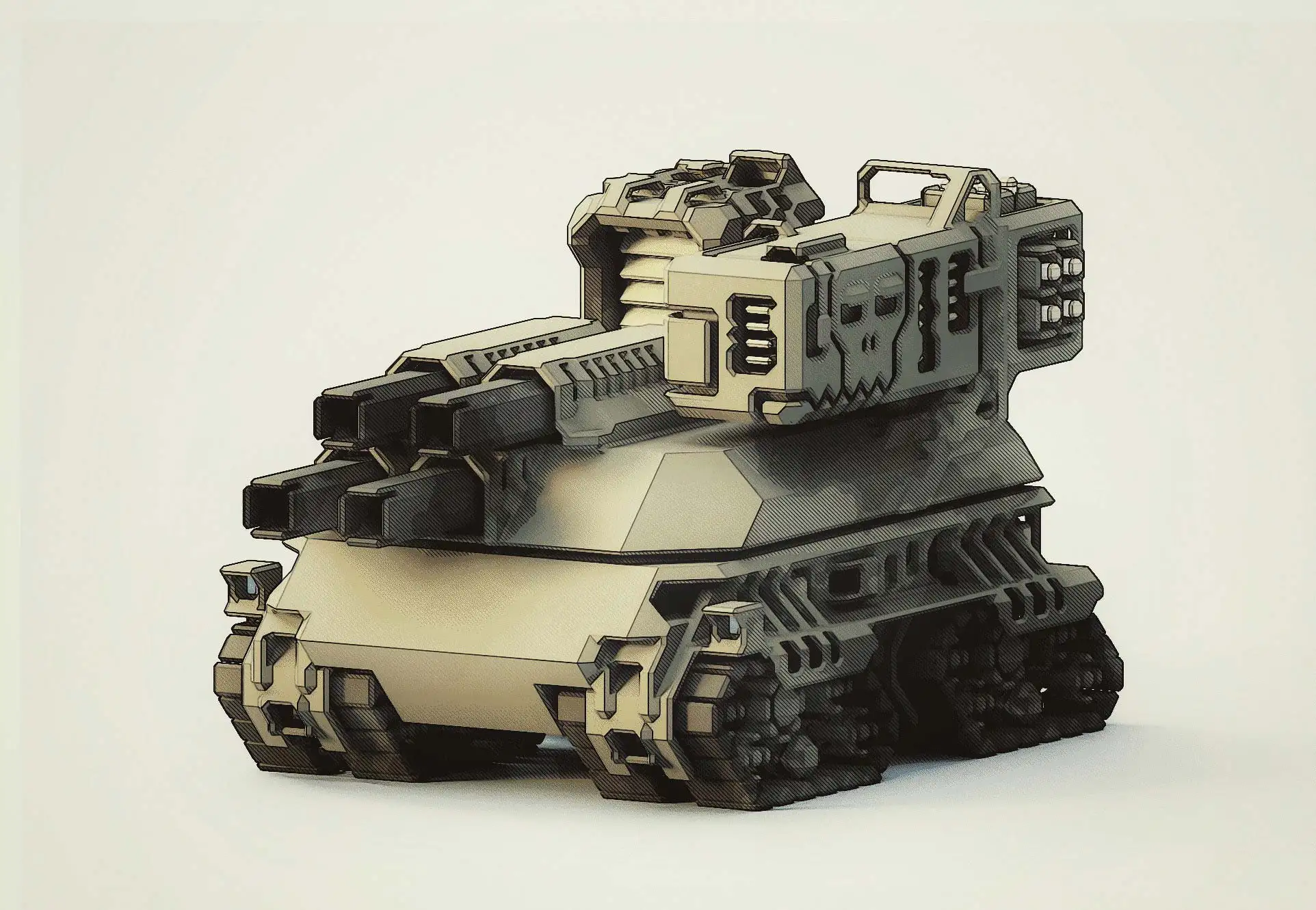
Turtok v1.0, config:(3(+1)) without multi-transmitter-receiver ultrasonic sensor set - タートック v1.0、構成:(3(+1)) 超音波センサーセットのマルチトランスミッターレシーバーなし
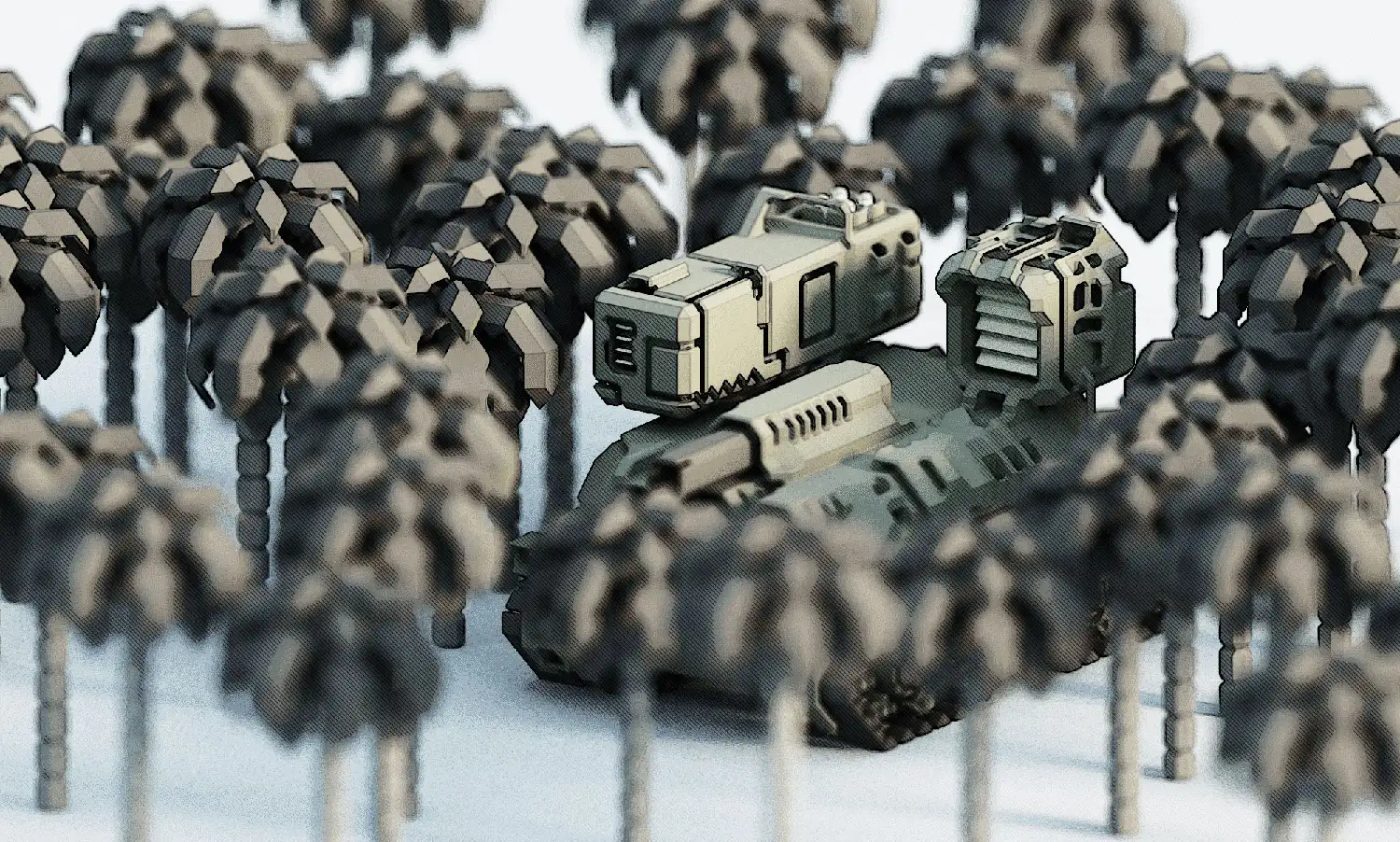
Turtok v2.0: alternative cannon configuration - タートック v2.0:代替砲台構成
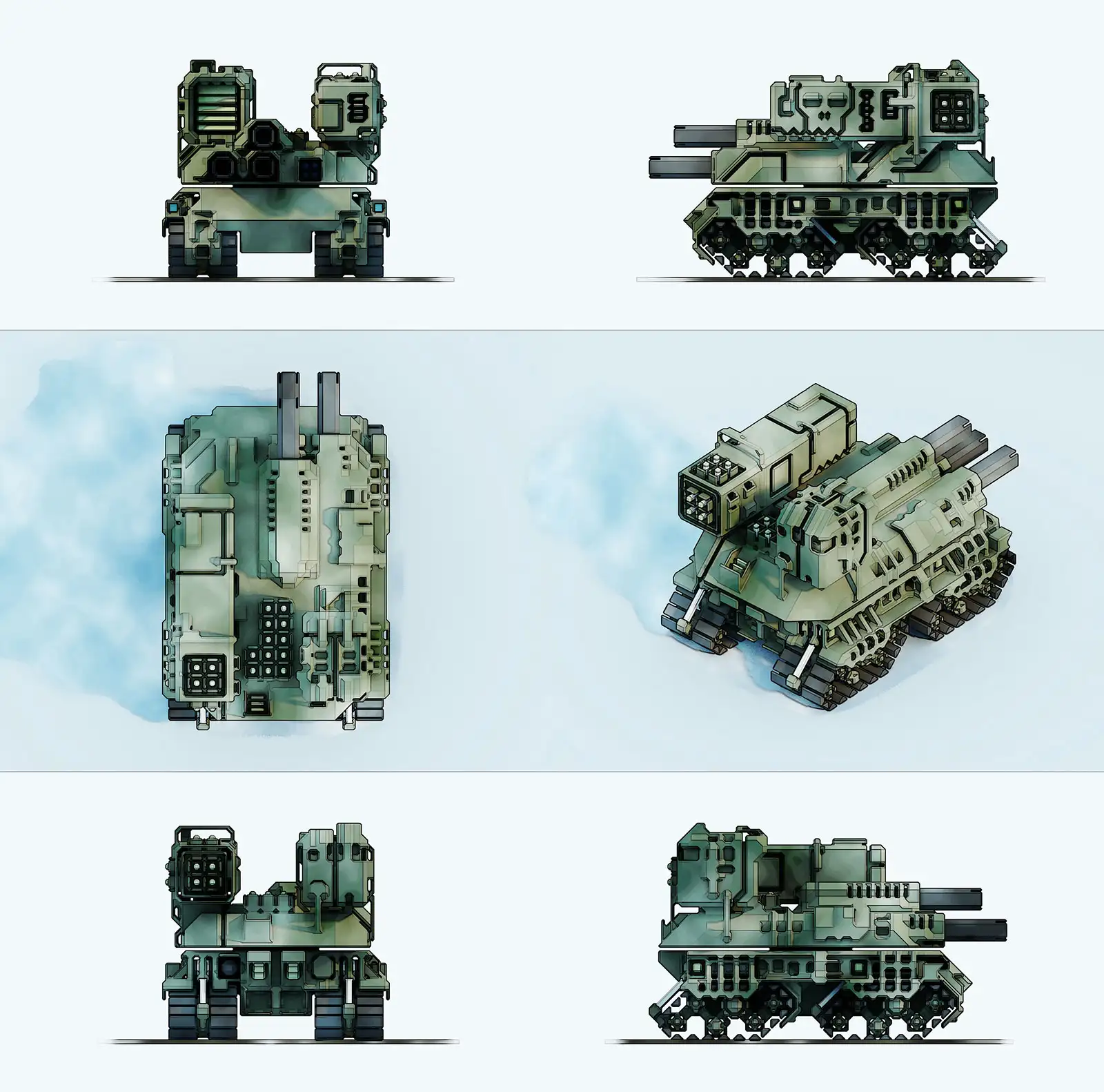
Turtok: Design Analysis - タートック:デザイン分析
Codename: Black Widow [コードネーム:ブラックウィドウ]
The Black Widow is an advanced eight-legged combat vehicle, ingeniously designed with inspiration from the form and functionality
of a spider. This cutting-edge military marvel exemplifies the fusion of high-tech robotics and strategic military engineering,
excelling in a variety of hostile environments. As an All-Terrain Autonomous Combat Vehicle (AT-ACV), the Black Widow offers
unparalleled agility and stability on diverse terrains, enabled by its six spider-like, articulated legs.
Each of the Black Widow's legs serves a dual purpose: providing mobility and acting as an integral part of its offensive arsenal.
Embedded within these legs are multiple air-to-air missile cartridges, equipping the Black Widow with a robust defensive ring
against aerial assaults. At its core, the vehicle houses two ballistic nuclear missiles, positioned for swift deployment and optimized impact.
A standout feature of the Black Widow is its sophisticated active armoring system. This responsive defense technology can
instantaneously detect and react to incoming threats, adapting the armor's density and composition to effectively counter a wide
range of attacks. This adaptability grants the Black Widow exceptional resilience against both conventional and unconventional warfare.
In essence, the Black Widow is a pinnacle in hexapod combat vehicle design, melding the inherent efficiency of a spider's anatomy
with the latest advancements in military technology, creating a highly formidable and versatile combat platform.
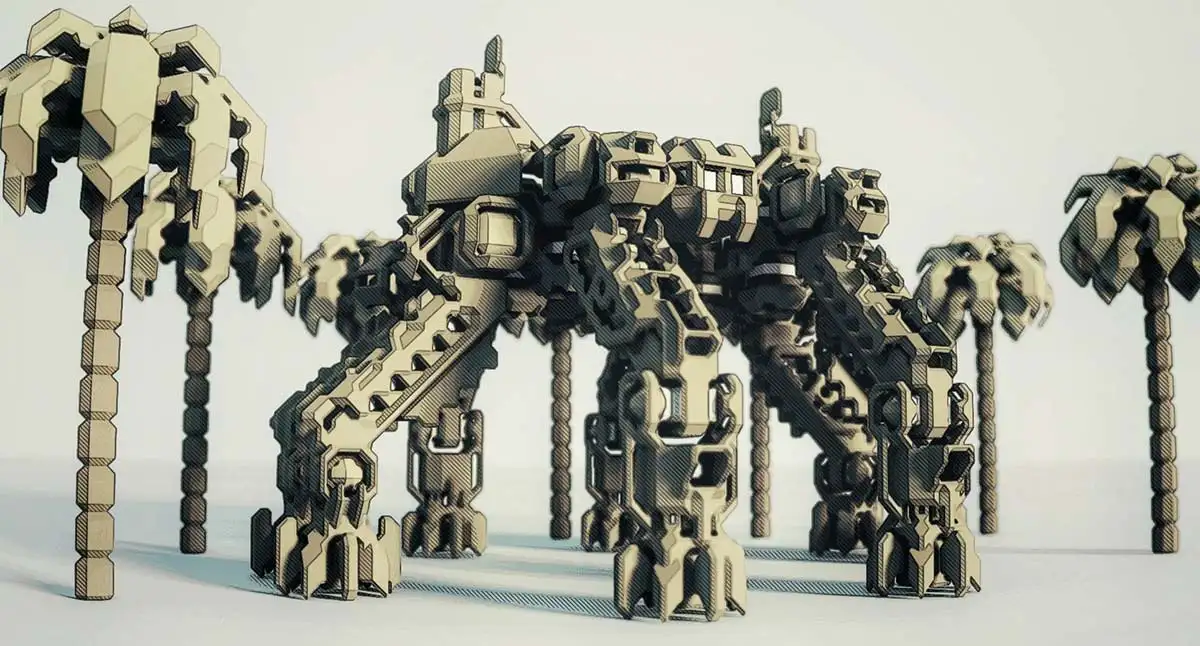
Codename: Black Widow - コードネーム:ブラックウィドウ
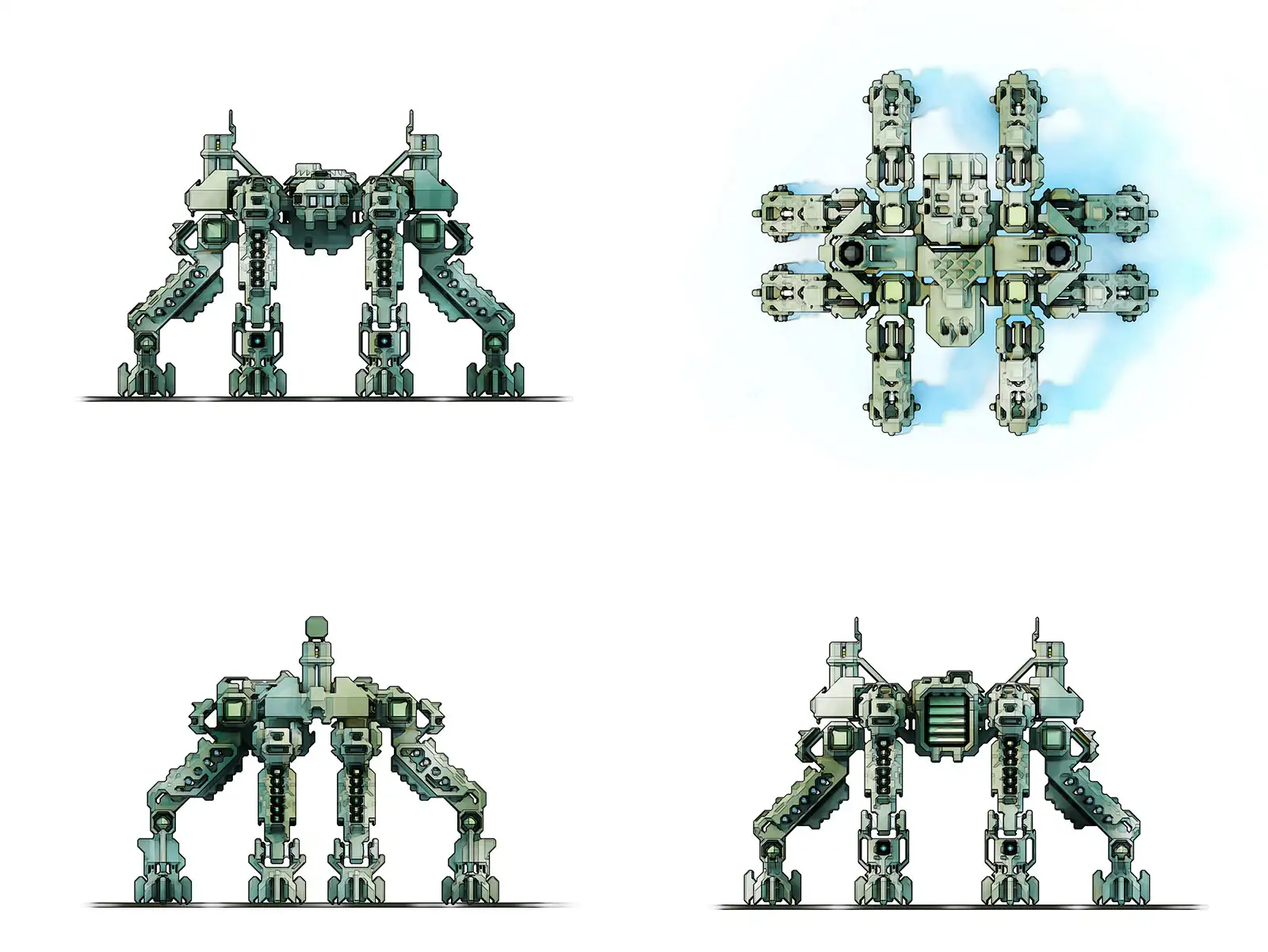
Black Widdow Schematics - ブラックウィドウの設計図
Codename: Crustacean [コードネーム:クラスタシアン]
The Crustacean is a highly advanced 2nd generation hexapod combat vehicle, ingeniously designed with inspiration drawn from the
formidable structure of a crab. This six-legged war machine represents a harmonious blend of natural design principles and
cutting-edge military technology, tailored for operations in challenging terrains such as dense forests. As an All-Terrain
Autonomous Combat Vehicle (AT-ACV), the Crustacean exemplifies exceptional mobility and stability, echoing the crab's versatile
movement in nature.
Each leg of the Crustacean serves a dual role. Not only do they provide remarkable maneuverability, but they also house a potent
offensive arsenal. Embedded within these robust legs are multiple air-to-air and anti-tank missile cartridges, providing the
vehicle with comprehensive defensive and offensive capabilities. The Crustacean's most distinctive feature is its giant crab claw,
ingeniously designed like a chainsaw. This formidable appendage, also equipped with air-to-air and anti-tank missile cartridges,
allows the vehicle to navigate and clear paths through dense forests and other obstructive terrains.
Stealth is another key aspect of the Crustacean's design. It can seamlessly blend into dense forests, entrenching itself for
concealment, making it a formidable ambush predator on the battlefield. Like the Turtok battle tank, the Crustacean is equipped
with the Central Complex Computing Platform (CCCP). This modular mainframe system governs autonomous movement and combat operations,
backed by a self-sufficient energy and cooling system to ensure uninterrupted functionality.
The Crustacean's defense is further bolstered by a high-energy shield generator. This generator creates a permanent electromagnetic
field enveloping the vehicle, extending up to 50 meters, offering an additional layer of protection. To prevent overheating, the
vehicle is fitted with a compact, high-performance multi-stage air inlet-outlet system. This system effectively maintains optimal
temperature conditions for its electro-mechanical components.
For offense, the Crustacean is equipped with a single cannon capable of firing tungsten carbide reinforced rounds. This cannon adds
a significant long-range attack capability, complementing its close-quarters combat prowess.
Overall, the Crustacean hexapod combat vehicle is a marvel of military engineering, blending the natural defensive and offensive
characteristics of a crab with the latest in military hardware and autonomous technology, making it a versatile and formidable
force on any battlefield.
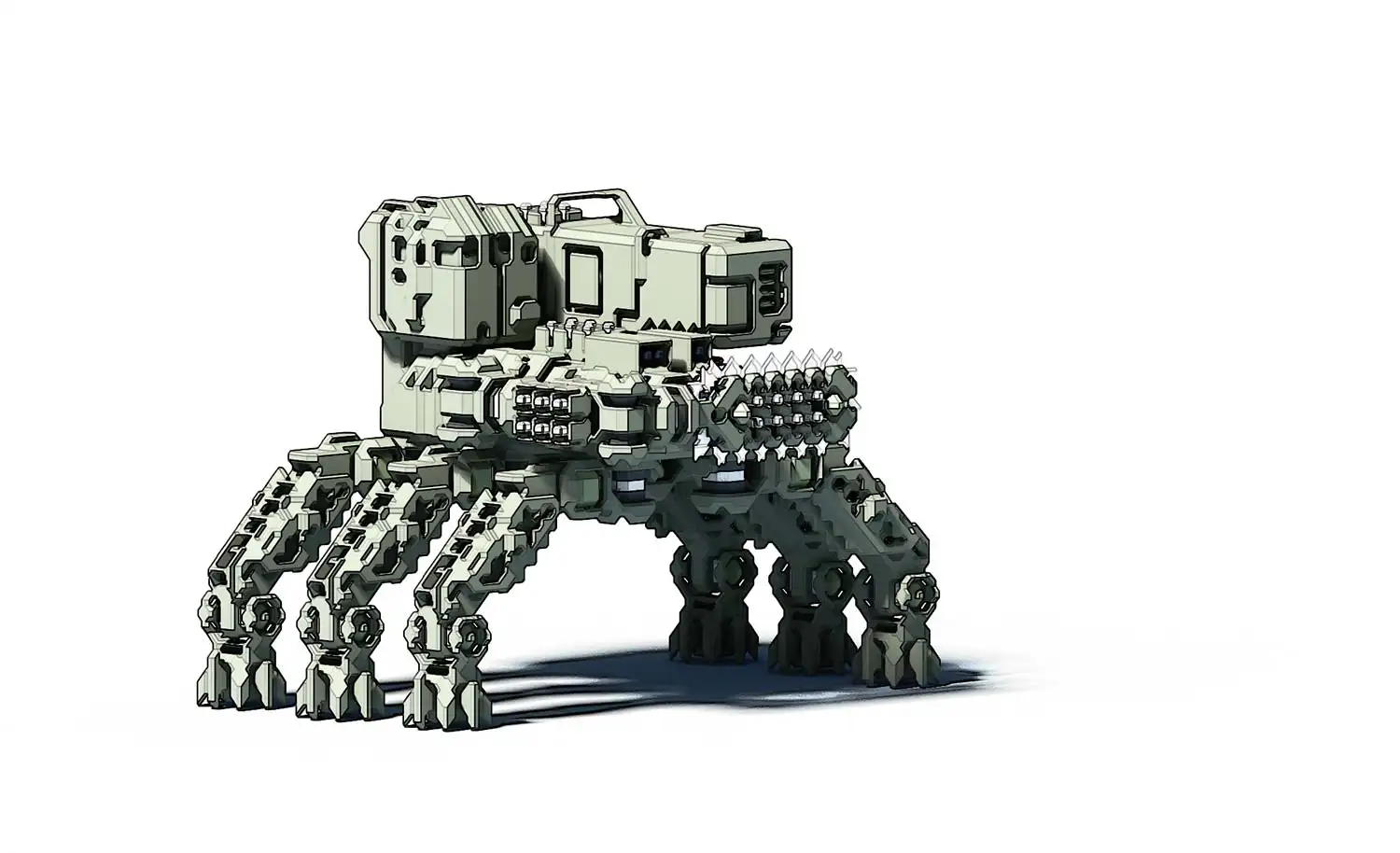
Metal Fear Crustacean - メタルフィア・クラスタシアン
Codename: Big Mouth [コードネーム:ビッグマウス]
The Big Mouth is a unique air vehicle, aptly named for its distinctive design feature: a large air intake situated beneath the
cockpit, resembling the open mouth of an orangutan. This drone-like aircraft integrates advanced technology with innovative design,
making it a formidable presence in the skies.
At the heart of the Big Mouth is the Central Complex Computing Platform (CCCP), a sophisticated modular mainframe system that controls
autonomous movement and operational procedures. This system is crucial for the coordination and efficiency of the aircraft's functions.
Powered by four turbojet engines, the Big Mouth is capable of performing vertical takeoffs and seamlessly transitioning into horizontal
flight. This versatility allows it to operate effectively in a variety of environments and mission profiles. The engines are designed
to rotate, providing the necessary thrust vectoring for its diverse flight maneuvers.
A key feature of the Big Mouth is its cargo hold, specifically designed to carry ballistic nuclear missiles. This strategic capability
is enhanced by the inclusion of a crane trolley system, enabling the aircraft to load and unload missile boxes with precision and ease.
For self-defense, the Big Mouth is equipped with a single cannon capable of firing tungsten carbide reinforced rounds. This powerful
weapon offers significant protection against surface and airborne threats. Additionally, the aircraft boasts a cartridge of 12 air-to-air
missiles mounted on top, ready to engage hostile targets and defend itself during critical missions.
Overall, the Big Mouth combines powerful offensive capabilities with versatile flight dynamics and autonomous operation, making it a
highly effective and formidable air vehicle in modern warfare.
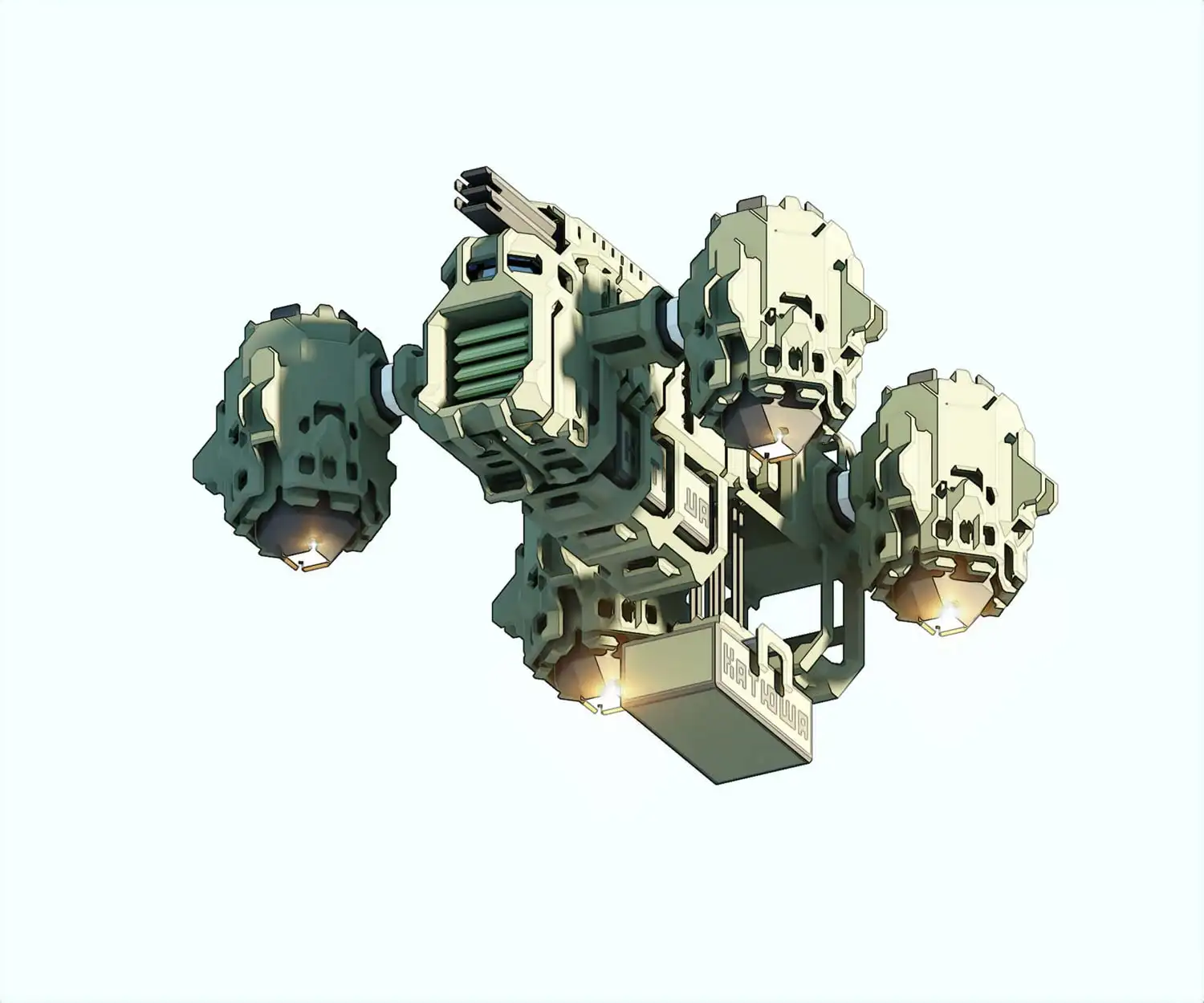
Big Mouth in vertical flight and hovering mode - ビッグマウス、垂直飛行およびホバリングモードで
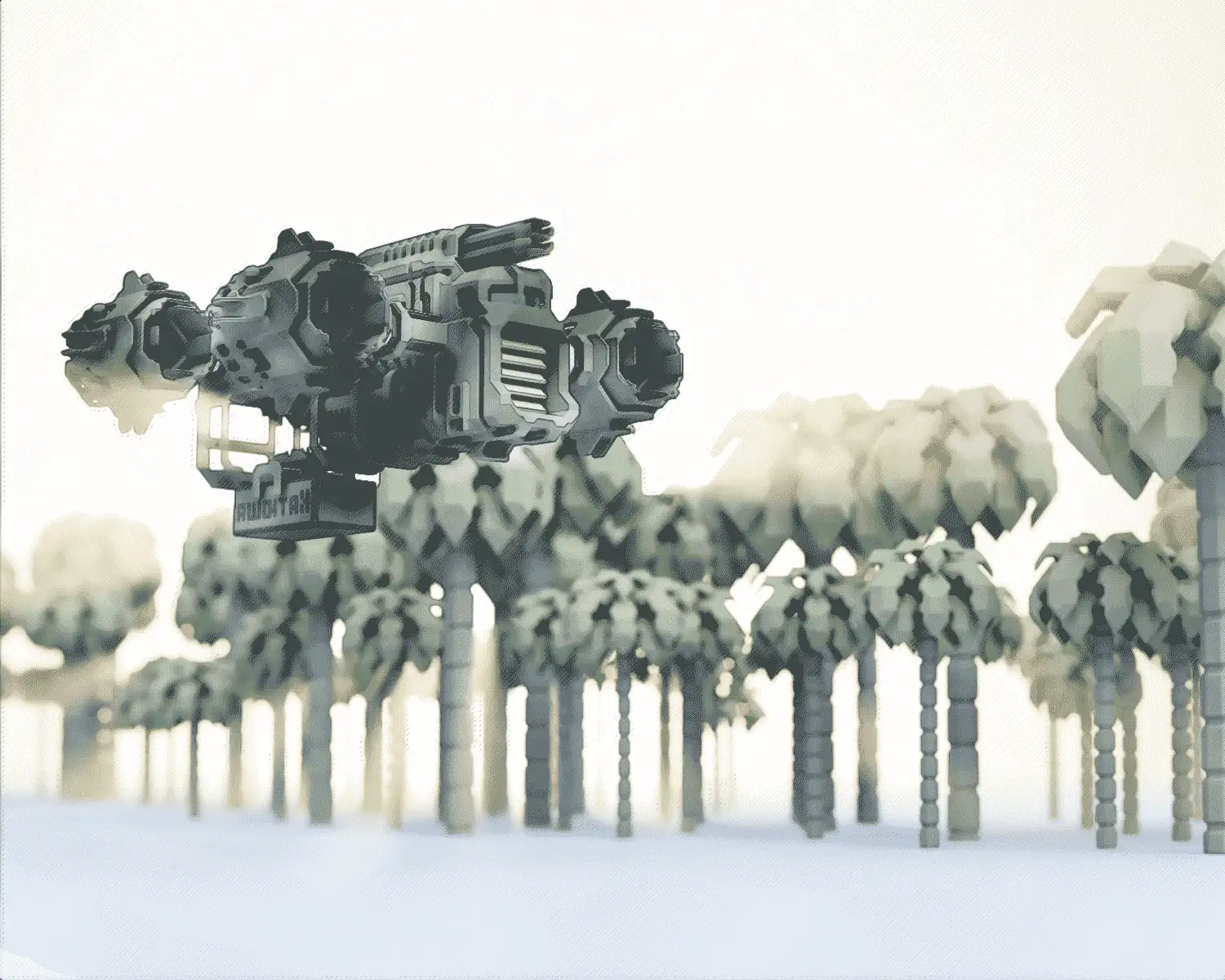
Big Mouth in horizontal sub-sonic flight mode - ビッグマウス、水平亜音速飛行モードで
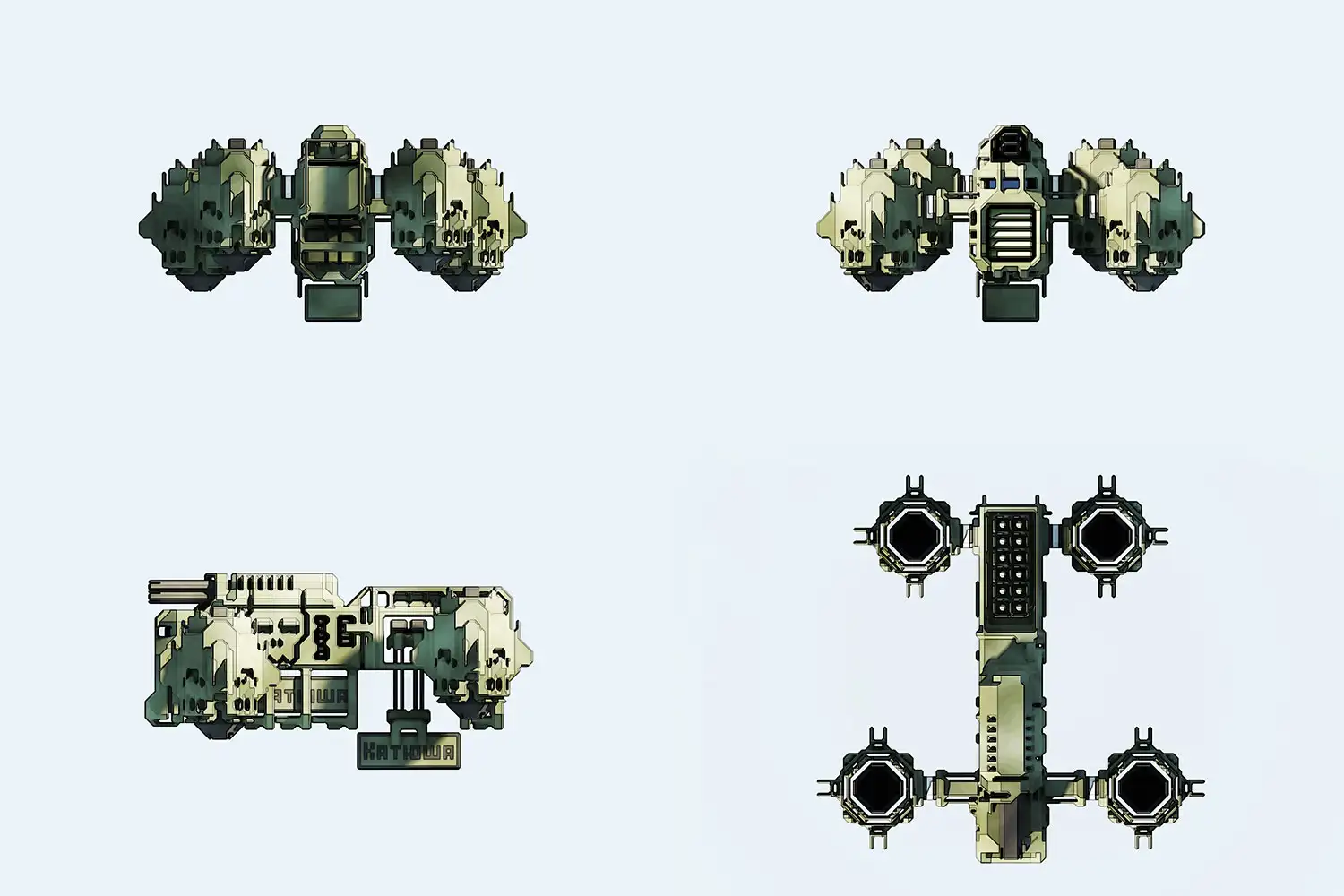
Big Mouth Schematics - ビッグマウスの設計図
Codename: ChoppRa [コードネーム:チョップラ]
The "CHOPPRA" is an innovative troop transport helicopter, distinguished by its unique coaxial rotor design. The name is a clever
blend of "Chopper," a common slang for helicopter, and "Cobra," reflecting its design inspiration and capabilities. The cockpit of
the CHOPPRA is designed to resemble the head of a cobra, complete with an expandable neck shield. This feature cleverly conceals a
formidable armament: 12 air-to-air missiles, six on each side of the cockpit. Further, the lower part of the cockpit is styled to
resemble an open cobra mouth, which cleverly houses the air intakes for the gas turbines. This design not only contributes to the
helicopter's striking aesthetic, but also serves a functional purpose, optimizing air intake for engine efficiency.
The CHOPPRA is not just about its striking appearance; it's also highly functional as a transport vehicle. It has the capacity to
carry 16 soldiers, providing a significant boost to troop mobility on the battlefield. In addition to its personnel capacity, the
CHOPPRA is designed to transport a lightweight armored all-terrain vehicle, enhancing its utility in various combat scenarios.
This combination of offensive capabilities, defensive features, and transport capacity makes the CHOPPRA an invaluable asset in
military operations, especially in scenarios that require rapid deployment and extraction of troops in challenging environments. Its
design and functionality represent a significant advancement in helicopter technology, offering a blend of agility, firepower, and versatility.
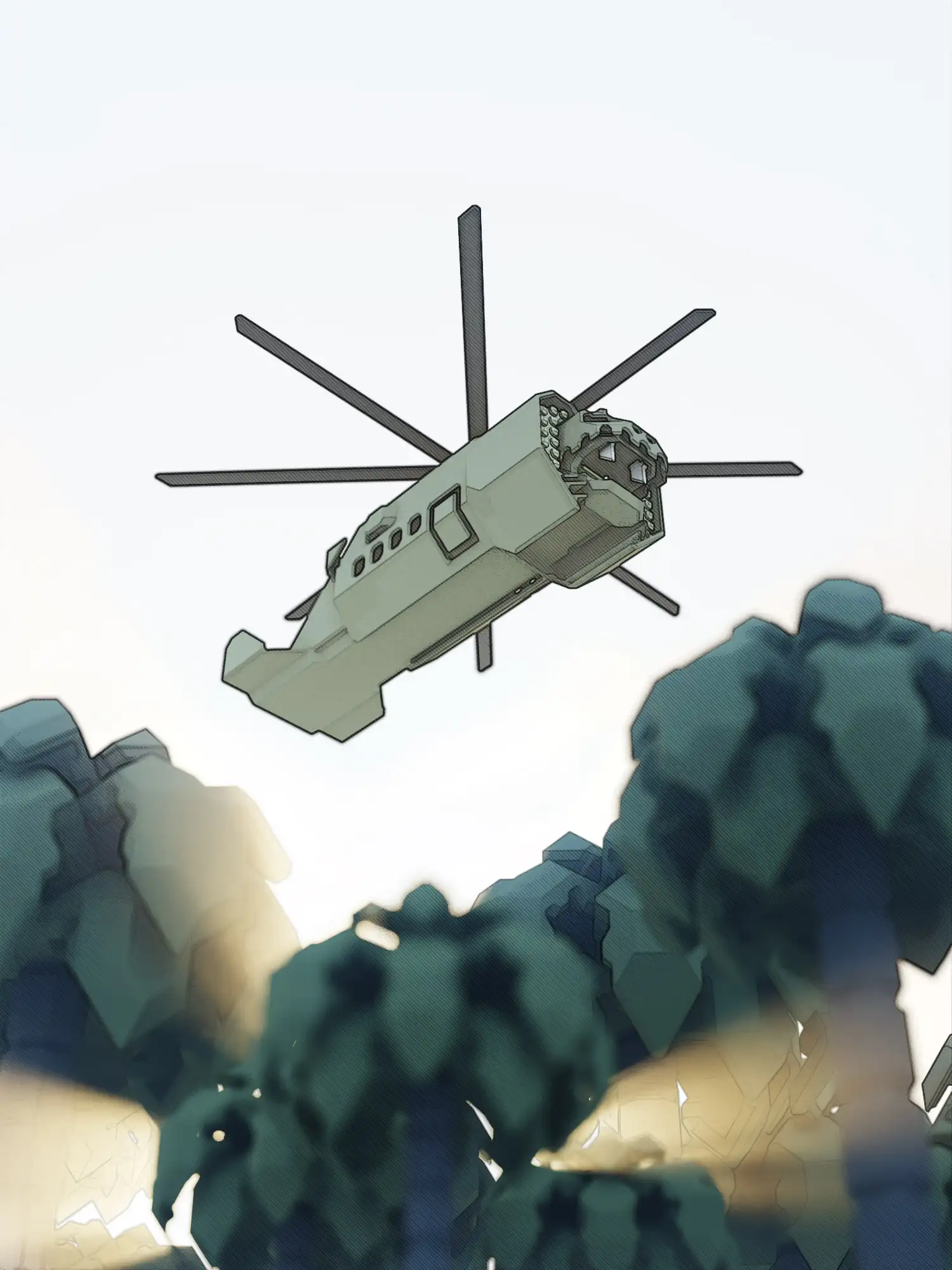
Codename: ChoppRa - コードネーム:チョップラ
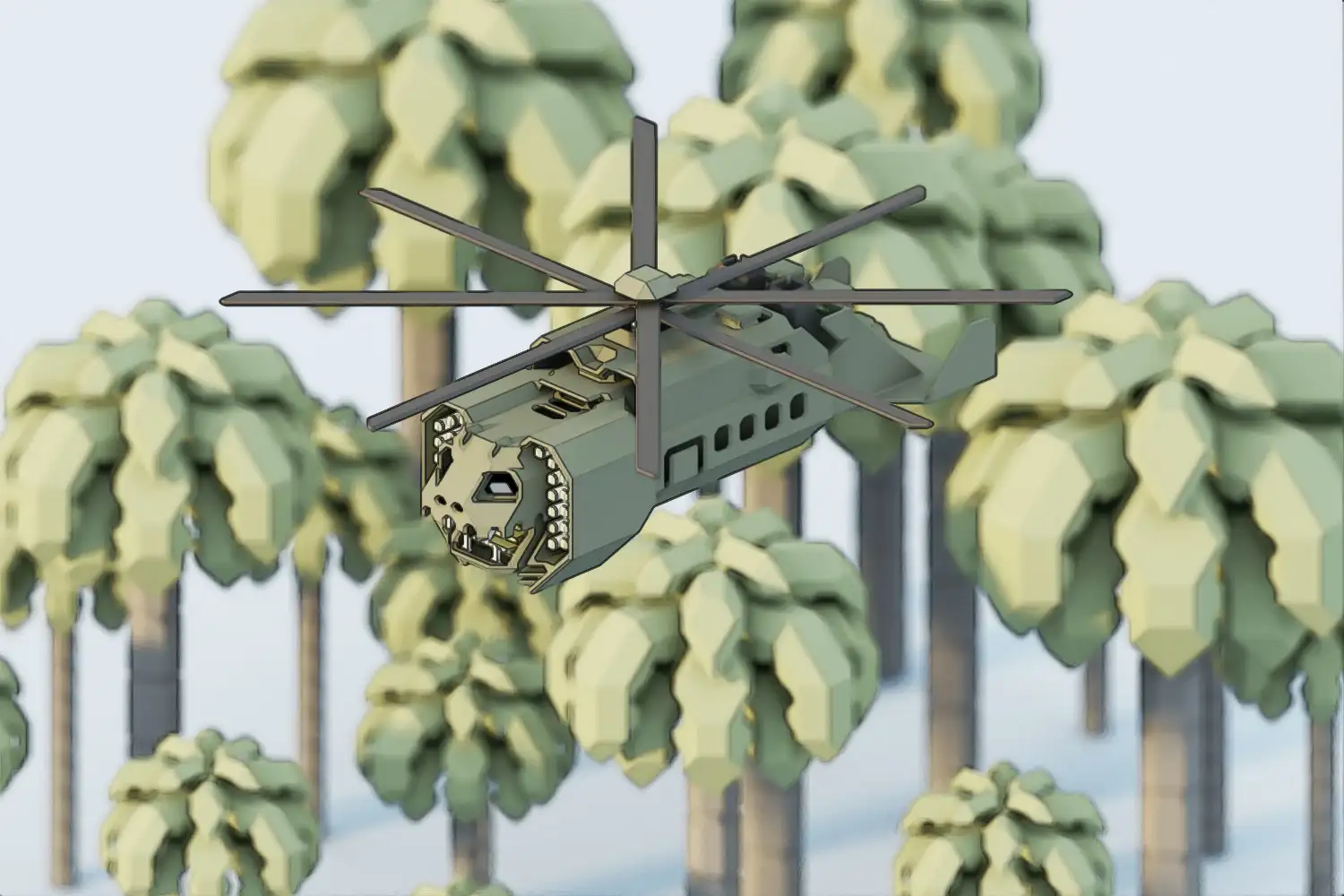
ChoppRa troop transporter with its characteristic "Cobra" like cockpit - チョップラ兵員輸送ヘリコプター、特徴的な「コブラ」のようなコックピット付き
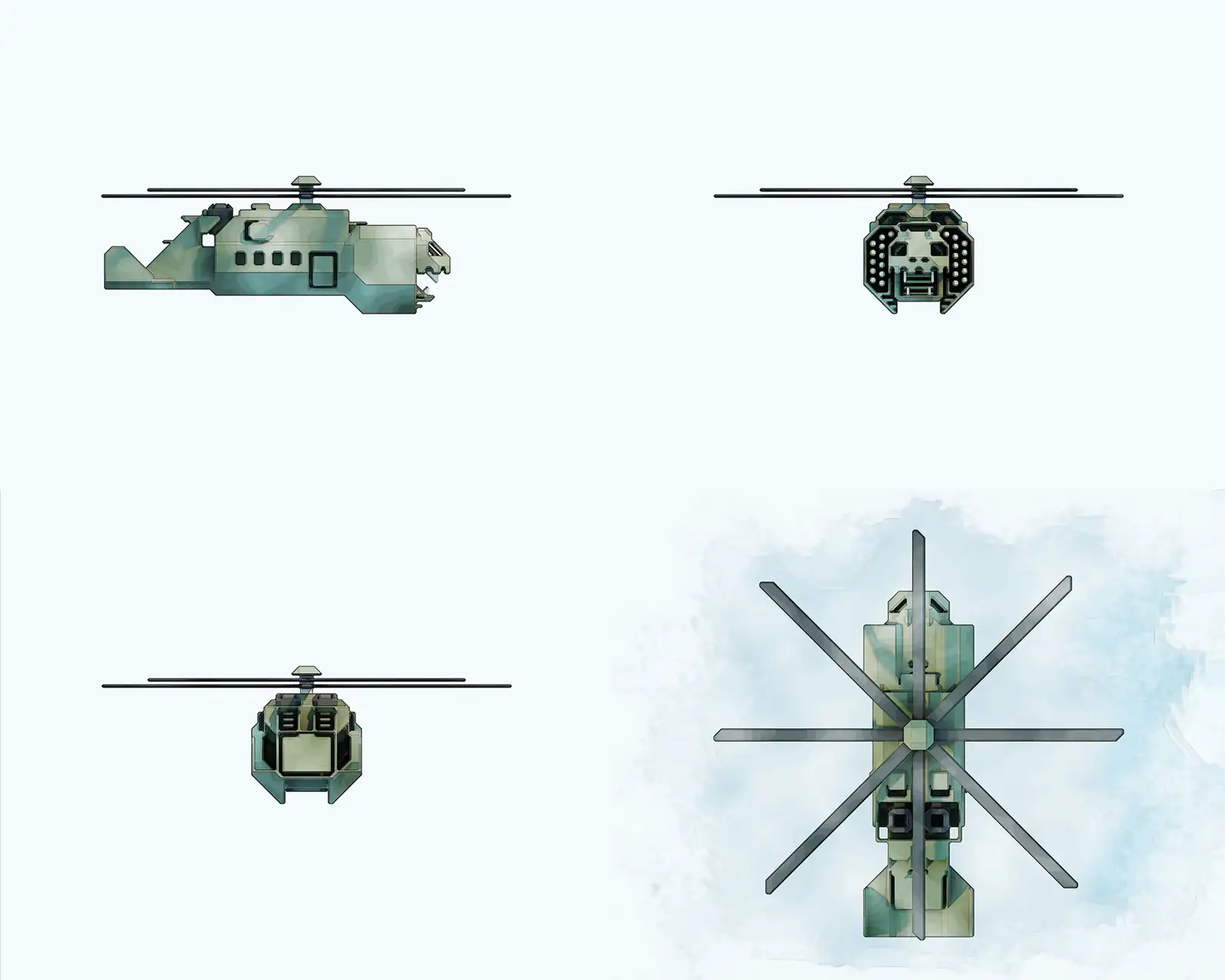
ChoppRa Schematics - チョップラの設計図