Table of Contents
Shape & Resistance
The role of surface topologies on aerodynamics
Perceptual Aerodynamics
Flow States as World Grammar
Surface Topology & Perceptual Physics
Perceptual Physics as a World Rule
Shape & Resistance
Shapes interact with air in unique ways, a concept crucial for industrial design and realism in concept art. A cube-like shape, confronting the air flow, creates tension and high air flow resistance. A cylinder, with its rounded shape, shows more harmonious motion with less air flow resistance. Finally, the aerodynamically perfect waterdrop shape or a wing shilhouette shows minimal resistance.
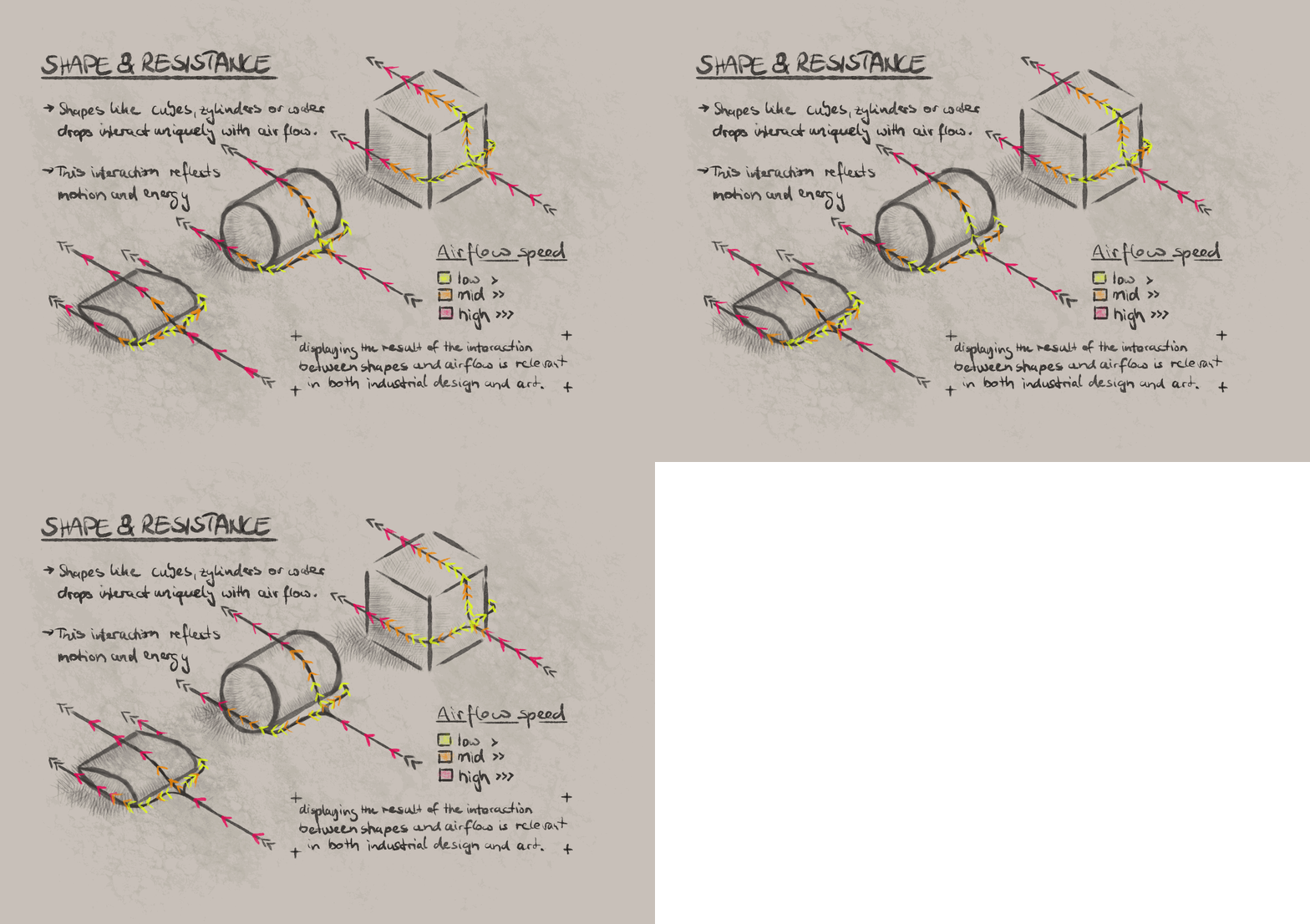
Impact of Shape & Resistance on Air Flow
Retroactively, imagine the wheat field scenario – observe how different parts of the field react differently to the wind, creating a tapestry of movement and energy.
The role of surface topologies on aerodynamics
Friction resistance comes alive when you depict how air flow interacts with various surface topologies. This could range from the sleek, yet solid surface of a wing to the uneven, yet flexible macro textures of a wheat field or other organic shapes. The resistance depends on the surface's smoothness and flexibility, as well as on the speed and density of the air flow.
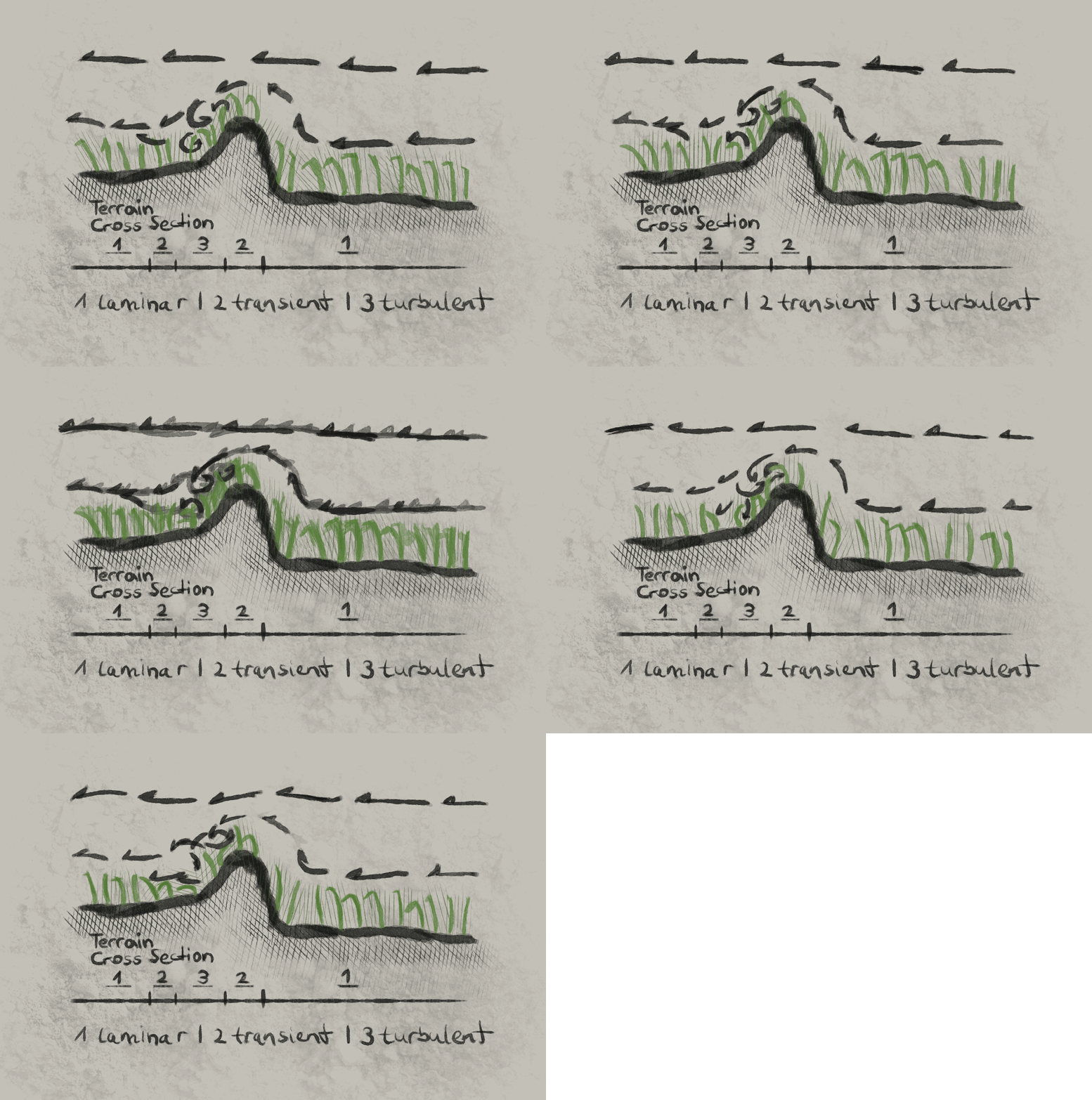
The role of surface topologies on aerodynamics
In concept art, taking surface topologies into account could be useful to define how air flow creates local and regional waves of motions across different surfaces, bringing a sense of flexibility and dynamics to environmental scenes.
Perceptual Aerodynamics
Aerodynamics are not simulated in most games and concept art — they are perceived. The goal is not physical accuracy, but visual coherence: making invisible forces readable through shape behavior, grouping, and transition zones.
Design Rules
- Air is never drawn directly — its presence is inferred through motion and deformation.
- Forces must create zones, not uniform motion across everything.
- Perceived physics must stay consistent across the whole scene or world.
- Visual order communicates calm; visual disruption communicates energy or danger.
- If a force exists, it must leave a readable trace somewhere.
How to start?
- Decide where the force comes from and where it dissipates.
- Define at least one stable zone and one disturbed zone.
- Never animate everything — leave reference points still.
Flow States as World Grammar
Flow states are a visual grammar. Laminar and turbulent behavior are not technical terms here, but readability states that help the player understand space, mood, and energy distribution.
Design Rules
- Laminar flow = ordered spacing, parallel motion, predictable rhythm.
- Transitional flow = bending, phase offsets, emerging irregularity.
- Turbulent flow = broken rhythm, local chaos, loss of alignment.
- Transitions are more important than extremes.
- Boundaries between flow states define hotspots and narrative tension.
How to start?
- Sketch motion as bands, not individual elements.
- Introduce chaos only at interfaces between bands.
- Use repetition first, then break it deliberately.
Surface Topology & Perceptual Physics
Surfaces do not just receive forces — they translate them. Rigid, smooth, folded, or flexible surfaces each tell a different physical story, even if the underlying system is simple or fake.
Design Rules
- Smooth, rigid surfaces preserve order and direction.
- Irregular or flexible surfaces fragment motion into local variations.
- Micro-motion should never contradict macro-motion.
- Local chaos must still obey global flow direction.
- Surface behavior is part of world recognition, not decoration.
How to start?
- Define macro flow direction first.
- Add surface response as a secondary layer.
- Limit variation — consistency beats realism.
Perceptual Physics as a World Rule
Perceptual physics is a story-relevant promise to the player. Once established, it becomes part of how the world is read and trusted. Breaking it accidentally damages immersion more than visual abstraction ever could.
Design Rules
- The world's physical language tells a consistent story.
- Effects exist to explain story, not to simulate physics.
- If interaction zones move, the world must react.
- Cheap simulation is acceptable; inconsistent logic is not.
- Readability always outranks physical correctness.
How to start?
- Write down your world’s physical lies.
- Apply them to cold (ambient) zones; let hot (interactive) zones stay readable.
- Test scenes by asking: does this feel physically honest?